





Agricultural Drone Common Sense
Time: 2025-11-25 15:02:07
An important tool in modern intelligent agriculture, agricultural drones silently change the concept of farming. They efficiently and precisely manage crops from seeding to irrigation. High-performance batteries ensure flight times that can support continuous operations to improve farming efficiency.
What Is an Agricultural Drone
Agricultural drones or unmanned aerial vehicles are designed for special crop management, mainly precision spraying of pesticides, herbicides, and fertilizers. Equipped with liquid storage tanks, they have the capacity to carry all sorts of agrochemicals for crops and bring about efficient coverage with minimal human labor demands. High-capacity batteries fitted into some drones ensure that flight times can be extended, hence allowing for long, continuous spraying operations while minimizing battery replacements that might interrupt a mission.
Modern agricultural drones have highly precise control systems and intelligent spraying technology that guarantee uniform application of chemicals and the process does not involve waste. In addition, sensors and imaging devices installed on such drones could monitor crop growth conditions and provide data support in irrigation, fertilization, and pest control for optimized use of resources and increased crop yield.
What Are the Types of Agriculture Drones
Multi-Rotor Agricultural Drones
The multirotor drones include quadcopters, hexacopters, and octocopters. They allow flexible hovering and low-altitude flight and can be applied in small or complex landscape farms. The cameras fitted on multi-copters are high-definition cameras, which are also used for monitoring crops. However, their endurance is normally from 10 to 20 minutes. Due to the high power consumption, high-energy-density batteries are used to extend the flight time a little and support full mission cycles.
Fixed-Wing Agricultural Drones
Similar to conventional aircraft, fixed-wing drones have better endurance and the ability for longer flying times. With the capability of surveilling huge farm areas fast either to map or to collect data, taking off and landing require a runway; hence, it limits usage over complex topography. Fixed-wing drones usually carry intelligent drone batteries for maintaining long-distance flights to ensure continuous data collection and spraying operations.
Hybrid Agricultural Drones
Hybrid drones integrate the vertical take-off and landing capabilities of multi-rotors with the advantages brought about by long-range flights, such as fixed-wing aircraft. They can fly in complicated terrains and can conduct extended missions by flexibly switching modes to enhance efficiency. However, they feature complex structures, high costs, and operational and maintenance requirements that are quite demanding.
The Use of Drones in Agriculture
Scouting or monitoring plant health
Drones in agriculture can be used to monitor health issues in crops. Essentially fitted with either NDVI or normal cameras, they analyze spectral or imagery data for the determination of pests, diseases, nutrient deficiencies, and abnormal growth patterns. Flying at low altitudes and capturing high-definition imagery, drones rapidly detect problem spots with far greater precision compared to satellite imagery, hence offering timely intervention data to farmers.
Monitoring Field Conditions
Drones monitor soil and field environments, creating highly detailed topographic maps with sensors and mapping technology that allow farmers to analyze terrain contours, drainage conditions, and wet/dry zones. The ability to monitor soil nutrients and nitrogen levels in real time enables precision fertilization and structural improvement in the soil, hence enhancing efficiency in agricultural management.
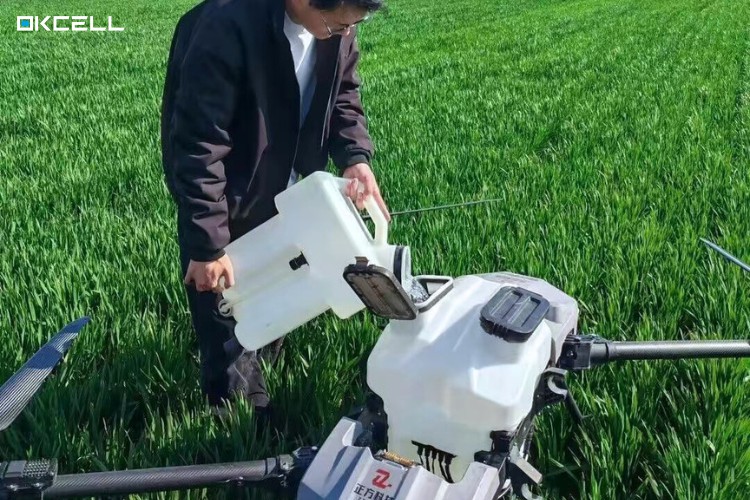
Planting & Seeding
In drone seeding, steep slopes and other hard-to-reach territories-for example, highly remote woodlands-show immense coverage and planting efficiency. Two operators flying ten drones can sow hundreds of thousands of seeds daily, meaning huge potential for future general agricultural applications. High-capacity batteries ensure drones can complete large-scale seeding without frequent recharging while maintaining the continuity of operations and maximizing planting efficiency.
Spraying Application
Drones for pesticide spraying are very much in use across Southeast Asia, particularly on high-altitude or complicated farmland terrain. Drones provide close control of spray coverage and dosage, minimizing risks of exposure to highly toxic pesticides by human handlers, waste, and environmental pollution, while improving operational efficiency. On the other hand, such adoptions have a number of regulatory constraints across different countries.
Security
A drone carries out farm security and inspection activities over wide and distant areas, transmitting real-time high-definition videos. The progress of crops and machinery conditions can be accessed by farmers on their computers remotely. For highly valuable crops or in pasture management, drones could replace some of the personnel tasked with carrying out inspections, hence reducing labor costs while increasing the efficiency and safety of such inspections.
Drone pollination
It is now in the R&D stage. By simulating the pollination behavior of insects, drone pollination technology delivers the pollen with accuracy onto flowers without causing any damage to the plants. With intelligent control systems, someday in the future, drones will have the ability to find flower locations and times of optimal pollination on their own, hence enabling precise management of crop pollination and raising agricultural intelligence. For autonomous pollination, battery reliability is key: drones must operate over extensive areas and time windows without disruption.
Drone AI
Artificial intelligence makes it possible for an agricultural drone to conduct crop monitoring and identification, even on a wide variety of crops with complicated planting patterns. With massive amounts of data learned and optimization algorithms, drones can identify the different kinds of crops with great precision, thus helping farmers in intelligent agricultural production by providing precise management and decision-making. Sufficient drone battery capacity is needed to support AI processing and continuous operation during monitoring missions.
Drone Irrigation
The microwave sensors used in this drone irrigation technology monitor soil moisture for precision irrigation on demand. By monitoring the humidity of the soil continuously, farmers can efficiently regulate the time and volume of irrigation with a minimum of waste to manage the scarce water resource. This makes crops more resistant to drought and thus promotes healthy plant growth for better and more stable agricultural output.
5 Key Benefits of Using Drones in Agriculture
Time Savings
Agricultural drones can be very efficient and fly over hundreds of acres in a single flight. Compared to traditional methods of agriculture, these activities undertaken involve great consumption of time and human labor, whether it be crop inspection, land surveying of farmland, or sprinkling pesticides. Drones are able to fly quickly and work at high precision, hence enabling large-scale tasks to be completed in a short period of time through drones, thereby greatly reducing the operational time while enhancing agricultural production efficiency effectively.
Labor Cost Reduction
Most work in agricultural production requires several workers to accomplish, such as land surveying and crop monitoring, in a few days. Agricultural drones facilitate several operators performing the tasks well and shortening the time consumed greatly. This not only reduces labor input and lowers labor cost but also helps to ameliorate the labor shortage issue in the production process.

Improved Crop Health Insights
Agricultural drones have special equipment, such as multispectral and thermal sensors, which are installed to identify early signs of growth stress, pest issues, and other crop problems. Real time monitoring and analysis of that information will allow farmers to know in time the health status of crops and take precautionary steps before the damage increases, therefore minimizing losses and ensuring healthy growth.
Optimized Input Usage
Rational use of fertilizers, pesticides, and water resources during agricultural production effectively enhances the yield and quality of crops, reduces the cost of production, and protects environmental integrity.
Agricultural drones contribute to precision agriculture technology by setting the quantity and range of spreading fertilizers, pesticides, and irrigation water precisely according to the needs of crops and field conditions. Consequently, agricultural drones minimize resource waste, decrease production cost, minimize chemical pollution, and develop sustainable agricultural production.
Better Yield Forecasting
With advanced analytic tools, agricultural drones can provide high-resolution and rich-data images, which will contribute to giving farmers more precise information on crop growth. Continuously tracking the growth process and making analyses enables the farmer to predict yields more precisely and make preparations for harvesting and sale in advance, increasing economic efficiency in agricultural production.
How to Choose Agricultural Drones
Buy through formal channels
First of all, in purchasing agricultural drones, the first consideration must be to prioritize formal channels made by reputable manufacturers. Usually, a manufacturer with a good reputation has strict quality checks and comprehensive quality system certification, which is conducive to guaranteeing product quality and performance. Buying through a formal channel can enable one to gain access to after-sales service or technical support at any time provided by the manufacturer; hence, such plans offer timely solutions when the drone malfunctions or needs some maintenance, something that actually protects the rights of consumers in practice.
Consider body material
The bodies of the agricultural drones should be made from a material that has an excellent performance due to the complicated and variable conditions of the agricultural field, including the unpredictable weather. Ensure that the body material, while choosing the drone, is lightweight but strong, durable enough, and rigid enough; it should also be waterproof and corrosion-resistant to bear the different harsh conditions in the agricultural field.
Corrosion resistance of components is guaranteed.
Agricultural production involves all types of pesticides, which can be classified by form into liquids, powders, solids, emulsions, and oil-based formulations. They could also be classified by pH into acid, alkaline, and neutral agents. Therefore, parts that would touch pesticides, like pipes and nozzles, should have good corrosion resistance against pesticide damage that could affect the functioning of the drones and spray efficiency.
Work quality guaranteed
Pay attention to the quality of work, operational efficiency, and spraying characteristics of the agricultural drones. In operational efficiency, during the spraying operation of agricultural drones, the amount of spray applied shall be controlled between 0.8-1.0 L/mu. Indicators like the deposition density of droplets per unit area, deposition coverage rate, droplet size, and droplet distribution uniformity in the characteristics of the spray influence droplets' adhesion and absorption on plant leaves, thereby influencing their effectiveness in controlling pests and influencing agricultural production efficiency.
Conclusion
With the continuous development and expansion of application scenarios, agricultural drones are expected to be an important pillar for agricultural modernization. It not only improves production efficiency but also delivers a reliable means for the realization of precision agriculture and sustainable development. In the future, agricultural drones will be more deeply integrated into farmland management, with their intelligence heightened, to promote innovation and optimization constantly in the mode of agricultural production.

点击右上角
分享给朋友吧







 Long by picture save/share
-

The Heart of Your Operation: A Complete Guide to the Agricultural Drone Battery
A deep dive into how agricultural drone batteries influence power, safety, flight time, and operational efficiency, offering essential insights on specs, maintenance, and choosing the right battery.
MORE -
How China Drone Battery Manufacturers Are Ensuring Quality and Safety
China’s drone battery manufacturers are raising industry standards through advanced engineering, strict safety controls, and reliable quality systems that ensure safer, longer, and more stable flight performance.
MORE -
Expert Guide to Agricultural Drone Battery Maintenance
Ensure safer, longer agricultural drone flights with practical battery maintenance guidance that helps prevent power loss, extend lifespan, and keep field operations efficient.
MORE -
What Are the Best Practices for Maximizing Drone Battery Performance
Maximizing drone battery performance starts with understanding how different missions stress power systems. Smarter charging, temperature control, and load management keep flights safer and longer.
MORE -
How to Charge a Drone Battery Safely and Effectively
Learn how to charge drone batteries safely and maximize performance with proper methods, smart charger choices, and essential practices that protect lifespan and flight reliability.
MORE -
Agricultural Drone Common Sense
Modern agricultural drones transform farming by enabling precise spraying, crop monitoring, and irrigation management, improving efficiency, sustainability, and smarter decision-making on farms.
MORE -
How Can Upgrading Your Drone Battery Improve Its Battery Life
Upgrading your drone battery can significantly extend flight time, stabilize power output, and improve reliability. Smarter chemistry and better design help every mission last longer and perform better.
MORE -
Essential Advice for Picking the Perfect Drone Battery
Discover how selecting the right drone battery impacts flight performance, efficiency, and reliability. Learn to match battery features with real-world needs for safe, stable, and long-lasting operation.
MORE -
How Custom Lithium Battery Packs Elevate UAV Performance
Custom lithium battery packs elevate UAV performance by extending flight time, enhancing stability, and ensuring safety, enabling drones to operate efficiently and reliably across demanding missions.
MORE -
Drone Battery Guide: Types, Safety, and Flight Time
Explore drone battery types, safety practices, and factors affecting flight time to maximize performance, extend lifespan, and ensure reliable operation for every mission.
MORE





Contact Us
With 18 years of extensive experience in battery production andcustomization, we have served thousands of clients. OKcell can providepersonalized one-stop customization services tailored exclusively for you.Contact us directly to explore our factory and products firsthand !
 Phone:+86 15093446331
 E-mail:sherry@izeron.com
 Address:Building 5, 5th Floor, 503, Yida Industrial Park Phase 1, Jinju Street, Zhengzhou High-tech Zone.
OKCELL Copyright © 2021 all rights reserved
Since 2005, with 18 years of dedication to custom battery manufacturing, supported by a team of 300 employees, multiple R&D centers, and 65 patented inventions, we are committed to becoming the world’s leading smart battery manufacturing service provider.
ABOUT COMPANY
CONTACT US
Email Address:
 :sherry@izeron.com
 :+86 15093446331
点击右上角
分享给朋友吧
OUR LOCATION
OKCELL is located at Building 5, 5th Floor, 503, Yida Industrial Park Phase 1, Jinju Street, Zhengzhou High-tech Zone.
OKCELL Copyright © 2021 All rights reserved
Technical Support:ShanHou